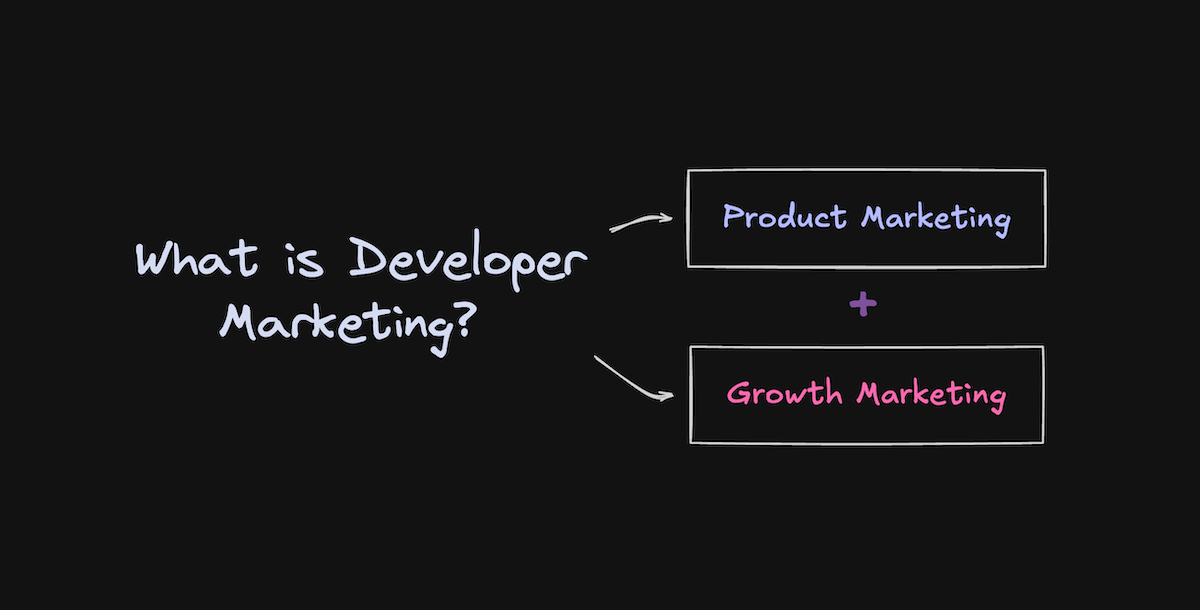
Developer marketing sits at the intersection of product marketing and growth marketing. You’re responsible for launches, messaging, and positioning, but also for how those decisions show up in campaigns, GTM, and adoption. The role owns the developer persona end to end and is accountable for both product-led and sales-led growth, not just shipping something.
The role runs in parallel with most marketing functions, from content and lifecycle to web, demand gen, and RevOps. The scope doesn’t stop at signups. You’re responsible for the full funnel, which means accounting for revenue, not just activation. If people sign up but deals don’t close, that’s still a problem to solve.
You’re also more technical than the average marketer. You’re closer to the product, the workflows, and the constraints, and you put developer trust first. Once that trust is lost, it’s hard to recover.
That combination is what makes developer marketing both exciting and difficult. The role comes with overlap, ambiguity, and frequent justification, especially in developer-first companies where everyone speaks developer and ownership is rarely clean.
Why this role exists at all
Most marketing is optimized to explain value at a high level. That breaks down when claims have to hold up under actual usage. Developers evaluate through workflows and constraints, and they notice quickly when something doesn’t.
Developer marketing exists because this kind of evaluation requires technical judgment before messaging ships. Someone has to pressure-test positioning against how the product actually behaves. Someone has to surface mismatches early, before they turn into sales friction, support tickets, or churn that no one planned for.
When that responsibility is missing, the gaps don’t disappear. They just move downstream, where they’re harder and more expensive to fix.
Why developer-first companies make the role harder to see
In companies built primarily for developers, developer context is everywhere. Marketing teams tend to be more technical and already speak to developers without translation. There’s a shared baseline for how developers think.
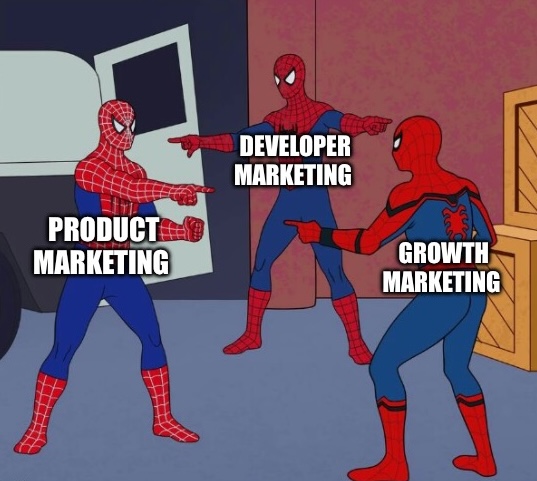
In those environments, developer marketing doesn’t always show up as a clearly defined function. The work spreads across teams. Parts of it live in product. Parts live in content, growth, or demand gen.
That’s where confusion starts. Not because the role isn’t needed, but because responsibility is diffused. Everyone contributes. No one is clearly accountable for how the product is framed and evaluated by developers end to end. The role doesn’t disappear in developer-first companies. Accountability just becomes harder to pin down.
Why technical chops matter more than familiarity with developers
There’s a difference between being adjacent to developers and having technical judgment. The first gives exposure and the second lets you evaluate whether something will hold up once it’s actually used.
Developer marketers need to be able to read content and recognize when something is glossed-over. They need to look at a demo and tell whether it actually holds up. They need to understand why a limitation matters before customers encounter it and turn it into a problem.
This isn’t about writing production code every day. It’s about understanding systems well enough to evaluate claims honestly. Familiarity with developer culture helps, but technical fluency is what makes the role effective.
What developer marketing is responsible for
Developer marketing is responsible for maintaining clarity and credibility with a technical audience, even when ownership across teams is messy.
In practice, that responsibility tends to show up in a few places:
- Shaping positioning and framing so it reflects how developers actually evaluate tools
- Validating that messaging aligns with development workflows, not idealized ones
- Surfacing mismatches early, before they ship and become someone else’s problem
- Representing developer reality consistently across product, sales, and marketing
This isn’t a checklist of tactics. When no one owns it, the gaps show up fast. Demos that fall apart under usage. Content that explains features but avoids constraints. Messaging that sounds right until someone tries to build with the product.
How developer marketing runs alongside other marketing functions
Developer marketing doesn’t replace product or growth marketing. In smaller companies, it often is product and growth marketing because one person owns the work end to end. As teams grow, the functions split out, but the responsibility doesn’t disappear.
In larger orgs, developer marketing becomes a coordinating role. Product marketing, growth, content, lifecycle, and RevOps have clear owners, but someone still has to keep the work aligned. Positioning has to match how the product actually works. Campaigns can’t get ahead of reality. Growth tactics can’t create downstream cleanup. That’s also why developer marketing experience scales into leadership. You’ve already had to own the whole system.
Developer marketing vs Developer Relations
Developer marketing and DevRel are often confused because they work with the same audience. They solve different problems. DevRel focuses on relationships, education, and feedback loops. Developer marketing focuses on clarity, positioning, adoption and revenue. There’s overlap in execution, but not in responsibility. They work best together. Things break when one is asked to replace the other.
Developer marketing in the AI era
The core responsibility hasn't changed. You still own trust, positioning, and credibility with a technical audience. But who that audience is and how they evaluate shifted. AI coding agents moved the constraint from writing code to describing what you want built. The people evaluating your product now include PMs, designers, and domain experts who build through prompts, not syntax. Developer content has two audiences now, humans and the AI agents helping them build. If your docs can't be parsed by an agent in Cursor or Claude Code, developers won't see your product at all.
I wrote more about this shift in End of coding, age of building.
How I think about being a better developer marketer
First, you should use the product. You should build with the thing you’re marketing. You should hit the same rough edges users hit and understand why they exist. It’s hard to explain limitations honestly if you’ve never run into them yourself.
Second, use AI aggressively, but deliberately. Automate repetitive work and invest in reusable tools, like a writing style guide or a Claude skill, so you’re not starting from scratch every time.
If you’re vibe coding, write instructions that explain what the generated code is doing. You should understand the structure of a codebase well enough to know where files live and how to update them manually if something breaks. Even if you work primarily in visual tools or AI editors, that baseline matters.
Build a sandbox. Have a place where you can play around with different dev tools and see how they actually behave. My site became my personal playground.
Learn from people who are close to the work and opinionated about it. I read an interesting question posed to potential hiring candidates, who do you think is doing marketing well? It made me run through the exercise and I think it’s important to follow folks who show their thinking, not just outcomes. Here are a couple folks that keep my wheels spinning, it a good way of course.
- Hank Taylor - Developer Marketing Advisor, CodetoMarket
- Morgane Palomares - VP of Marketing, Braintrust
- Randall Degges - VP of AI Eng & DevRel, Snyk
- Steve Sewell - CEO, Builder.io
- James Hawkins - Co-CEO, PostHog
I keep most of this thinking written down so I don’t have to relearn the same lessons every time. I collect articles, threads, talks, and tools as gems. Over time, that gets distilled into my developer marketing handbook, which is where I capture how I approach personas, messaging, enablement, and GTM strategies when developers are part of the equation.
A note on how I actually apply this
I keep running into the same questions when I’m doing developer marketing work. What actually matters here? What’s noise? Where am I about to overcomplicate something or gloss over a constraint that will come back later?
One example is a Developer Marketing Claude skill I built that turns my developer marketing handbook into an interactive reference. I plan to use it to get oriented quickly and sanity-check decisions when I’m moving fast. It’s not meant to replace judgment or thinking. It’s there to reduce the cost of starting from scratch every time.
I’ve also published a developer marketing cheat sheet that pulls together roles and responsibilities, along with distribution channels and metrics. It’s intentionally lightweight and doesn’t require an email to download. If it’s useful, take it. If it’s not, ignore it.
What the job actually demands now
Doing this work well today requires more than knowing channels or tactics. It requires technical literacy, comfort operating between teams with unclear responsibility, and a willingness to be specific even when that means accepting tradeoffs. Most of all, it requires accountability for trust and revenue, not just reach.